Below is the link for the after lab survey. It will ask you to give the name of the lab that we did. The official title is "How Can Color be Used to Determine the Mass Percent of Copper in Brass" Thanks for doing the survey. Also, if you want to earn even more extra credit, I need at least five students to complete a quick post lab assessment. It is only one queston and involves using a Beer's Law plot to determine the concentration (molarity) of a copper solution and then using the copper ion concentration in a stoichiometry calculation. I will give extra credit on top of the extra credit you are receiving to finish the post lab assessment. Have a good summer if I do not see you again until next fall.
Mr. Brueckner
http://www.zoomerang.com/Survey/WEB22FN77H2M5P
Thursday, May 17, 2012

Saturday, May 5, 2012
AP Chemistry Test Information for Monday, May 7th
- The AP Chemistry test begins at 8:00 a.m. on Monday, May 7th, 2012. The test will be given in the auxiliary gym. Be at school at 7:30 a.m. There was some discussion in class on Friday as to what type of writing utensil could be used. I cannot find that only pens can be used, but I do not doubt it. Bring both. I will have a bunch of pencils and ball point pens in my room, so you can come and borrow both from me. Also, if you need to borrow a calculator, please come and see me. Make sure that your batteries are good before going into the exam.
- Please go the the Events Calendar. All VODCast solutions for the Day 7 review packet are posted under the dates Friday, May 4th and Saturday, May 5th.
- As you review for the test, make sure that you review all of the free response problems from last week and all of the problems from the Friday morning review sessions. Also, going over the free response problems done in class from the last two units (Thermochemistry and Electrochemistry) would be a good idea. Everyone should have both copies of the multiple choice practice exams given. In both packets, a partial solutions guide to 1999 has been supplied and a full solutions guide to 2002 has been supplied. Make sure that you go through both of those tests and cover the material that you missed when taking the practice tests.
- Another good form of review is to go back and watch the old VODCasts given throughout the year. Just page back through the months of the Events Calendar. A total review of the gas laws can be found in November. Also in November are the VODCasts covering the independent study in organic chemistry. Naming of compounds, writing chemical formulas, and simple stoichiometry VODCasts are made available on the first page of the AP Chemistry webpage. Do not work all (or any) of the problems, but if you just watch, it is a good way to refresh your memory on the concepts.
- You can also page back through the entries of the blog to look at solutions to problems that were given as a way to review past concepts.
- The format of the test is first the multiple choice section then the free response section. You will have 90 minutes to answer 75 multiple choice questions. You will only be given a periodic table for the multiple choice exam. You will need to remember basic equations and do simple calculations without the aid of a calculator. You will have a list of equations and constants for the free response section of the test. You will have two parts to the free response section. Part (A) is the part of the free response test that calculators are allowed. You will have 55 minutes for part (A). Part (B) does not allow calculators and is when you answer conceptual questions. You will have 40 minutes to finish part (B). The multiple choice part of the test is worth 50% of your overall grade and the free response is the other 50%.
- On the second part of the free response test, the reactions section of the test will be given. Do not spend more than 10 minutes (if even that - I would shoot for 5 to 7 minutes) on that section. Remember, you get at least one point for writing correct reactants, so do that at least. Write only the net ionic equation. Know the BIG FIVE solubility rules. Anything that does not fit, assume it will be a precipitate will form.
- In all of the VODCast solutions dealing with equilibrium, I showed I.C.E tables. If determining the equilibrium concentrations is not dependent upon it, in the interest of time, do not show them. Do show the equation, with values, used to determine the unknown value.
- Remember, you are not only studying for the AP Chemistry exam, but also for the final for the AP Chemistry class, which will count for 20% of your semester grade. The test will given over a total of three days. On Tuesday, May 8th, you will take the multiple choice section of the final. On the AP multiple choice test, you get roughly 50 seconds per question. The multiple choice test for the final will be designed with 46 multiple choice questions to be completed in a 55 minute time frame. Wednesday, May 9th, you will be taking the 40 minute free response section (conceptual questions, equations supplied, but no calculator). On Thursday, May 10th, we will be tie-dyeing. On Friday, May 11th, the calculator portion of the free response part of the test will be given. You normally have 55 minutes for this part of the exam, but will only be given 50 minutes. I will remove parts of the original questions to make it fair terms of time. On Monday, May 14th, I am going to reserve that day for any make-up exams that need to be completed.
- On Monday, May 14th, if you have completed all exams, you will be released from class or you can be part of the process of participating in the trial lab for the new AP Chemistry curriculum. You will receive extra credit for participating in the trial lab event. You will be required to do the lab and submit a graded lab report to receive the extra credit. Your lab reports will be sent to the national AP offices to be critiqued for the effectiveness of the lab. Taking part in a trial like this is special and something that you could include on a resume for college. I will definitely include it in a letter of recommendation if I write one for you.
- Remember, I will curve the final and then add the extra credit that you have earned by coming to the early morning sessions and the practice exams. After studying for the real AP Chemistry exam, you should not need to day any more studying for the class final. I will make sure to choose questions that address material that we have covered extensively in class and during the review process.
- For the class final, you will have an equilibrium problem for the first part of the calculator portion of the free response section. I will also guarantee you a reaction rate, thermodynamics (entropy, enthalpy, Gibb's free energy) and electrochemistry question in the either of the two free response sections of the test. I will also guarantee you a question covering chemical reactions like the two given in class in the last week of review.
- Feel free to call or text me on my cell phone if you have any questions as you study. You should all have my number. If not, call someone in class that may have it or email me. I will check my e-mails frequently over the weekend.
Wednesday, April 4, 2012
Ksp Problems - Solutions
Below are the solutions to problems 3, 4, and 5 of the Ksp packet. Just like the weeks prior to spring break, we will be having a quiz on Friday, April 6th, 2012 on an old AP Chemistry test problem like the problems presented in this packet. Before the quiz on Friday, I will use the 1st 20 minutes of the period reviewing with you. Tomorrow, (Thursday, April 5th, 2012) you will be completing the Ksp / Titration Lab. The lab write-up will be due on Monday, April 9th, 2012 so you can spend tomorrow night preparing for the quiz.
On Tuesday, April 3rd, 2012, we worked problem #2 of the Ksp packet. We finished all but part D of the problem. The answer to D is not a numeric value, but rather a conceptual answer. We determined that strontium fluoride compound would begin to precipitate first because of having the lower Ksp value. The percentage of anion (fluoride ion) present when the other precipitate begins to form will be zero. This is because the stronger attraction that strontium ion has for fluoride ion over sulfate ion will cause only strontium flouride precipitate to be formed. Only after the last fluoride ion has been captured and the strontium ion concentration has increased will the precipitate strontium sulfate will be produced.


On Tuesday, April 3rd, 2012, we worked problem #2 of the Ksp packet. We finished all but part D of the problem. The answer to D is not a numeric value, but rather a conceptual answer. We determined that strontium fluoride compound would begin to precipitate first because of having the lower Ksp value. The percentage of anion (fluoride ion) present when the other precipitate begins to form will be zero. This is because the stronger attraction that strontium ion has for fluoride ion over sulfate ion will cause only strontium flouride precipitate to be formed. Only after the last fluoride ion has been captured and the strontium ion concentration has increased will the precipitate strontium sulfate will be produced.
- Number 3, part B is an ICE problem with an initial concentration of one of the reactants. This will inhibit the right shift that would occur if no products were initially present. "x" is added to both products as a Change because the initial concentration of magnesium ion is zero.
- Number 3, part C gives initial conditions of both ions that can form a precipitate. Whenever initial conditions are given, you must determine the "Q" value to see if it exceeds the Ksp value and a precipitate will form. The molarities and and volumes of each solution are used to determine the millimoles of each ion and then divided by the total volume after the solutions have been poured together. The Q does not exceed Ksp, so no precipitate will form.
- Number 3, part D requires you to think about LeChatelier's Principle. Because the concentration of magnesium decreases after heat is added to the system (the temperature went up), a left shift towards the solid reactant had to occur. Since the equilibrium system must try and remove some of the heat added and the left shift occured, heat must be a product. This makes the dissolving of magnesium fluoride an exothermic reaction.


Number 4, part B (i) asks for the solubility of zinc hydroxide in a solution that already contains hydroxide. The fact that the solution already contains hydroxide ion is that a pH with a value greater than 7 was given. Finding the initial concentration of is shown in the solution to the problem. The presence of hydroxide initially inhibits the right shift of the zinc hydroxide dissolving. This reduces the amount of zinc hydroxide that can dissolve.- Number 4, part B (ii) is a beast. The first thing that must be determined is if a precipitate will form, thus Q must be found. The millimoles of each ion are found and then divided by the total volume of solution once both solutions have been added together to determine the initial concentration of each ion. The Q ends up being larger than the Ksp, so a precipitate forms. The problem then turns into a limiting and excess reactant problem to determine which ion (zinc or hydroxide) is in excess. A BCE table is used. Know that equilibrium will be established again, so the millimoles of the excess hydroxide will be divided by the total volume of solution from adding the two solutions together. If you can do a problem like 4 B (ii), you ROCK!


The solution to part C in #5 is a conceptual question. The question states that solid still remains in the beaker. This means that the solution is still saturated with silver and bromide ions. Therefore, the concentration must be the same value that was calculated in part B because the system is still at equilibrium even though there is a larger volume of solution.- The answer to part D seems like a silly answer (5.0 grams of AgBr in 37,000 liters of water), but it does make sense if you think of how hard it is to dissolve silver bromide with a fairly low Ksp value. The concentration of the 5.0 grams of AgBr in an unknown amount of water must be equal to the concentration determined in part B. After converting to mole of AgBr, I just solved for the unknown volume of solution.
- Part E only asks you what is observed and not to determine the concentration of any ions after equilibrium is established again. This means that "Q" must be found using the conditions given. The millimoles of silver ion (from silver nitrate) and bromide ion (from sodium bromide) were found by muliplying the volume of each solution by the molarity of each solution and then dividing by the total volume (12.0 mL) after the two solutions are added together. In this problem, the Q exceeds Ksp, thus a precipitate is formed.
- I will do a demonstration on Friday, April 6th to illustrate part F. I will explain it more then.


Thursday, March 22, 2012
Solutions to Buffer Problems
Below are the solutions to AP Buffer problems #3 through #5. I know that I said that I would only supply the solutions to #3 and #4, but I liked a couple of the aspects of #5. One aspect of #5 is part b when the Kb value is to be calculated, but no concentrations are given to do this. This can be accomplished by knowing the weak acid that the base came from. Kw can be divided by Ka to determine the Kb. Tomorrow's quiz is another old AP Chemistry free-response question dealing with acid-base equilibrium with a focus on buffers. There will also be a question on determination of acid strength. Remember, this can be determined by knowing the Ka value or the structure of the acid. The structure, to be a "stronger" weak acid is to either have more oxygens or a more electronegative element in the acid structure. Come see me before class if you have any further questions. Remember, there is a study session tomorrow at 6:30 a.m.


Tuesday, March 13, 2012
Solutions to Acid / Base Equilibrium Problems 4 through 6
Below are the solutions to the acid / base equilibrium problems #4 through #6. The solutions to #4 are included even though they were presented in class. Tomorrow, you will have a quiz over the types of problems presented in the packet of old AP Chemistry exam questions dealing with acid / base equilibrium. In the bulleted text below, I have attempted to explain some of the more difficult parts of the questions.

- #5 part (c) caused some confusion in class. The acid (hypochlorous, HOCl) is reacted with the strong base sodium hydroxide (NaOH). Whenever a weak acid or base is reacted with a strong base or acid, the strong base or acid reacts completely. The reaction is not shown at equilibrium, but rather with only a right arrow showing a complete shift to the right. All of the hydroxide is consumed and converted into water and the conjugate base OCl^-1. Notice that the spectator ion Na^+1 was not included in the net ionic equation. This balanced equation will be needed for problem (d) (ii).
- #5 part (d) (ii) is a very involved problem. The moles of hydroxide ion will react completely with the weak acid HOCl. All of the moles (or millimoles) of hydroxide will be converted into water and the conjugate base OCl^-1. That is the reason that the B.C.E. table is shown. The moles (or millimoles) left of the HOCl and OCl^-1 after the reaction is completed will be used to determine the initial concentrations of each to re-establish equilibrium. Each ending mole value (or millimole value) will be divided by the total volume of 0.0400 liters (for moles) or 40.0 mL (for millimoles). The initial concentrations of each will then be used to determine the hydronium ion concentration when equilibrium is re-established.
- #6 (a) (iv) shows a B.C.E. table to illustrate that all of the moles of hydroxide ion (equal to the moles of NaOH found in question 6 (a) (iii)) will convert into moles of the conjugate base benzoate (C6H5COO^-1). The intent of the question is to determine if you know that the moles of the strong base will completely react and convert to the conjugate base.
- #6 (a) (v) is a different problem in that the initial concentration of benzoic acid (C6H5COOH) is not given. This can be treated just like any other unknown variable in an I.C.E. table. Once the equilibrium concentratio of benzoic acid is determined, the volume given in the problem can be used to determine the moles of benzoic acid present. The initial and equilibrium concentrations are considered to be the same since the change amount is miniscule compared to the initial value.


Wednesday, February 22, 2012
LeChatlier's Worksheet Solutions
Below is the key for the LeChatlier's worksheet. You will have two questions that relate to this worksheet on tomorrow's exam. Remember, tomorrow's test is entirely free response (written). Please go over the calculations for the lab. Remember, if you end up with a negative value in your ICE table, you did something wrong!!


Saturday, February 4, 2012
Practice Test for Reaction Rate Unit - Solutions
Below are scans of the practice quiz given out in class on Thursday. Unfortunately, I cannot upload the pdf of the practice exam like I said in an earlier post. If you did not get a copy of the practice exam, you will just have to use the images below. Also, an explanation to problem #19 is below. Also, the practice exam did not cover any nuclear material from the Chapter 21 work packet. There will be questions pertaining to nuclear chemistry on Monday's exam.
- Problem #19 could be solved with a calculation using the equation to find activation energy (Arrenius Equation - don't worry about the name). A simpler way (and the expected way) is to notice the trend of increase in temperature and rate constants. The increase in temperature of 20 Kelvin (273 K to 293 K) had a rate constant "k" increase of 0.046 to 0.081. A roughly 20 Kelvin increase in temperature (293 K to 310 K) should also cause another 0.04X increase in the rate constant. Therefore, 0.081 + 0.04 = 0.12.

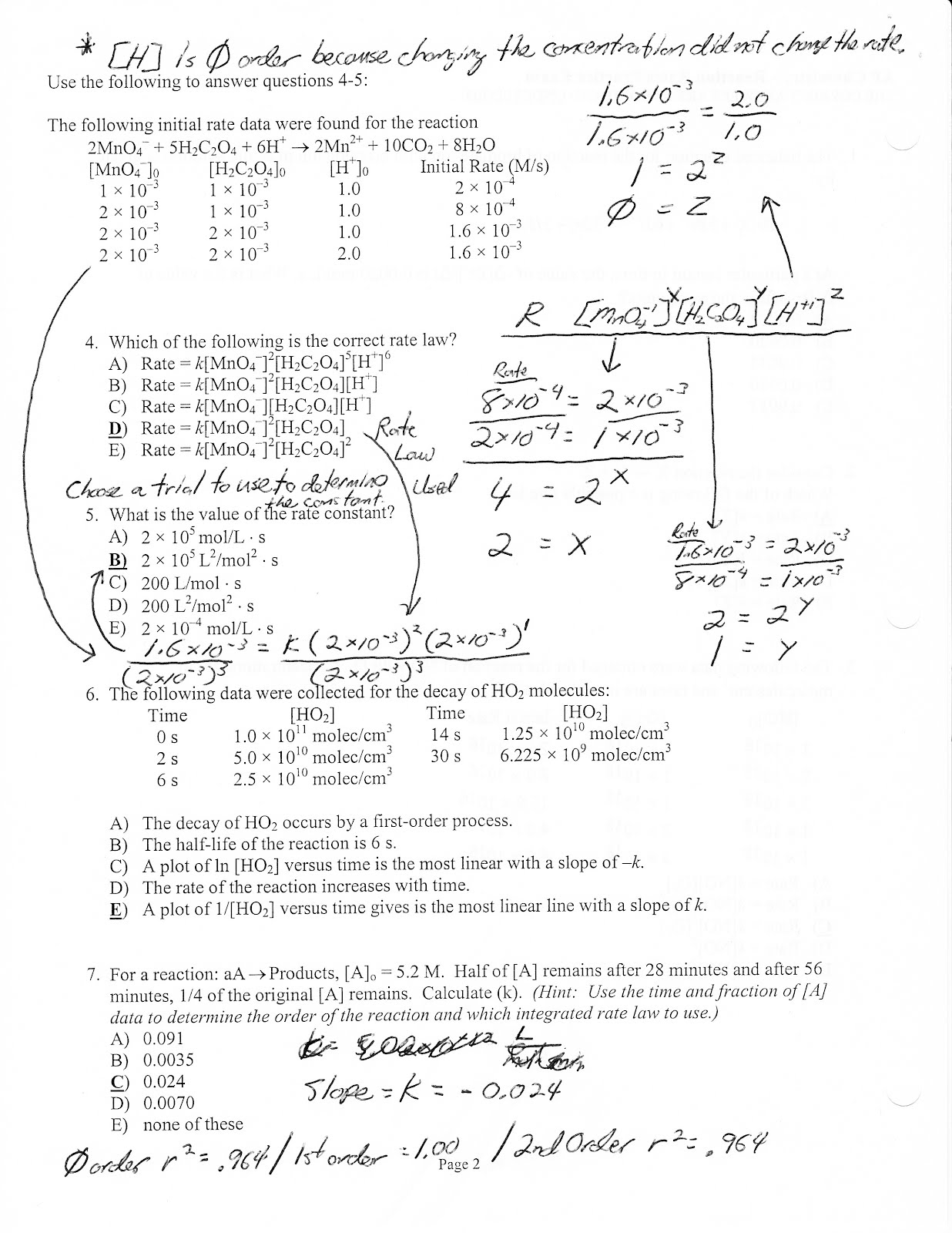


Integrated and Differentiated Rate Law Quiz Solutions
Below are the solutions guides to the quiz handed in on Thursday. I will try and grade the quiz and input your grades into Infinite Campus by Sunday morning so you can gauge how well you did.


Friday, February 3, 2012
Snow Day! Snow Day!
I hope everyone took the opportunity to sleep in. Great thing about this snow day is we can accomplish everything needed to get ready for Monday's Chapter 14 and 21 exam from the comfort of our own homes. Please periodically keep coming back to blog for information over the weekend. I will be doing the following:
- I will post a pdf copy of the practice exam on the Events Calendar if you did not get a copy in class. It will be under the date Friday, February 3rd.
- I will post a solutions guide to the practice exam on the blog. Look for that either later today or tomorrow (Saturday, 2/4).
- I will post a detailed explanation of the exam later on the blog. The test will be both multiple choice and free-response / written questions from old AP Chemistry exams.
- All VODCasts for the work packets (Chapters 21 and 14) given have been posted on the Events Calendar. They exist in the months of January and February, so you will have to go between the two months. I will be collecting the packets on Monday and giving you credit for completing the packets. Please do not just copy answers, but actually try to work the problems. The work packets are your best means of preparing for the exam.
- I had hoped to return your take home quizzes to you today in class. Even though I cannot do that, I will be posting the solutions on the blog later.
I will check my email regularly throughout the weekend. You can also call my cell phone. If you do not have my number, email me and I will send it to you. Have fun with your snow day. I am going sledding later.
Mr. B
Tuesday, January 17, 2012
Chapter 13 Review
Under the date, Tuesday, January 17th, 2012 on the class Events Calendar, a pdf. for the solutions to the Chapter 13 review is available.
Tuesday, January 10, 2012
Freezing Point Depression Take-Home-Quiz
Please answer the four questions presented below. Show all work used for your answer determination. On the class calendar under the date January 12th, 2012, there is a VODCast over the problem presented in class today. That may be of some help as your try and solve for the problem below.


Monday, January 9, 2012
Raoult's Law / Molar Mass Determination
Please complete the quiz below for class tomorrow, Tuesday, January 10th, 2012. A nonvolatile solute will lower the vapor pressure of a solvent. The mole fraction (Greek letter - chi) for Raoult's Law will always be for the solvent, so it is the moles of solvent divided by the total moles of solution.


Tuesday, December 13, 2011
Final Exam of 1st Semester
Thursday, December 15th, 2011 is your last exam of the 1st semester. It will cover all of chapter 11 and part of chapter 13. The test will be both multiple-choice and written (free-response) consisting of questions from old AP Chemistry exams. You were given a review packet in class of old AP Chemistry exam questions. I have supplied a pdf. file of the solutions to the review packet on the AP Chemistry calendar under the date, Tuesday, December 13th, 2011. The packet is meant to give you feedback for the correct answer, but also be used as a teaching tool to give you fairly a deep understanding of the concept. If you have any questions, come and see me before Thursday.
Tuesday, December 6, 2011
Bonding Strength Quiz
Answer the three questions of the quiz below. The answer from which types of bonding comes from previous lectures but also from today's lecture.


Wednesday, November 30, 2011
Thermodynamics Question
Below are the three questions that you need to answer for tomorrow, Thursday, December 1st, 2011. This will be graded at the beginning of class on the due date.


Friday, November 18, 2011
Organic Chemistry Independent Study
As I have promised, you will be given the opportunity to complete an independent unit of study over the Thankgiving holiday break. This unit of study is completely voluntary, but it is something that will help you on the AP exam next may. I have mapped out below where all of the resources can be found can be found and what the procedure will be for finishing the material.
The independent study will cover Organic Chemistry, which is Chapter 25 in your book. This will be a short, but complete unit on the chemistry of carbon. AP Chemistry is a course designed to be equivalent to an upper level college freshman chemistry course. Therefore, after the successful completion of freshman chemistry, a chemistry, biology, pre-med, or chemical engineering major would move on to a year long course in organic chemistry. The branch of organic chemistry in the chemistry tree is the largest. It is the chemistry that is the back-bone of the pharmaceutical industry, petroleum industry, and almost everything you buy without a prescription at the corner drugstore. Thousands of new chemicals are discovered every year and the vast majority of them are organic compounds. It is incredibly important, so a very minor amount of information known about it will be a benefit to you. This would help as you possibly move on to AP Biology, or get a 4 or 5 on the AP Chemistry exam and possibly move right into organic chemistry in your first year of college, or most important for right now, see a couple of questions pertaining to organic chemistry on the AP Chemistry exam. I do not cover this material in class because it historically is a very minor part of the exam and there just is not enough time to cover everything during the course, but also enough of the exam that it could be the difference for some to passing the exam or moving to the 4 and 5 region of the exam.
THIS INDEPENDENT STUDY UNIT IS OPTIONAL AND NOT REQUIRED FOR THE COURSE. IT IS DESIGNED TO BE AN ENRICHMENT TO THE COURSE AND A MINOR PORTION OF THE AP CHEMISTRY EXAM.
The unit will consist of you reading the chapter and studying the Chapter 25 Power Point that is available on the class Events Calendar, completing a practice test, and then finally completing a written take home quiz that will turned into me at the beginning of class Monday, November 27th, 2011. This take home quiz will be 20 questions. This is an opportunity for you to add a really good score to your assessment grade. It will be open book, open note, open internet, and open study buddy if you choose. I would suggest that everyone who wants to improve his or her grade take this opportunity and also those that are really serious about scoring well on the AP Chemistry test. The test is the only part of this independent unit of study that will be graded.
- The Chapter 25 Power Point can be found on the Events Calendar of my AP Chemistry web-page under the date of Fiday, November 18th, 2011. I have eliminated about 1/3 of the chapter from the Power Point. The independent study will focus on the classifying and naming of organic compounds and certain functional groups. Also, molecular geometry, bond angles, and hybridization that was learned in the previous unit will be applied to organic molecules.
- The Chapter 25 practice exam will be a .pdf file found on the Events Calendar under the date Friday, November 18th, 2011. The practice test consists of 32 questions. For each question, page numbers in the book have been given to guide you to the area in the book that you will need to read and study to answer the question.
- A VODCast of all of the solutions to the practice test will be posted to the Events Calendar under the date of Saturday, November 19th, 2011. It will be more than just answers. I will use the practice test as an opportunity to teach a deeper understanding of the concepts associated with each question.
- On Sunday, November 20th, 2011, the actual take home quiz will be posted on the Events Calendar as a .pdf file. You will need to print the quiz and complete it and be ready to turn in at the beginning of class, Monday, November 27th, 2011.
Below are links to four video resources that I found on the web that could be of use to you as you complete this independent unit of study.
- A VODCast/Power Point from Professor Chuck Wight of The University of Utah. This was designed for a first year chemistry course (like AP Chemistry) at UU, so it fits our needs quite well. Please keep in mind that the take home quiz will focus on material covered in the practice test, so some of what is presented you will not be held accountable for. Prof. Wight covers many functional groups that I will not be focussing on. The functional groups that I will hold you accountable for are alcohols, amines, halogens, and carboxylic acids. These four and all of the other functional groups can be found on page 1071 of your book. This YouTube video has a running time of almost eight minutes.
- The second VODCast that you can watch covers specifically how to name organic compounds. The naming system is governed by an international organization called IUPAC. You may see this acronym as you read the chapter or look on the internet. The acronym stands for International Union of Pure and Applied Chemistry. This YouTube video has a running time of just over nine minutes.
- The third internet resource that you can watch is a fairly humorous and catchy tune about naming organic compounds. There is a video accompanying the song. It is a good source to really condense many of the naming concepts for organic compounds. This YouTube video has a running time of two minutes and forty seconds.
- The fourth internet resource that I have to offer is a very short video that shows the resonance structure creation of an organic compound benzene. It does a very good job of illustrating the overlap of un-hybridized "p" orbitals to form the "pi" portion of a double covalent bond. You will read quite a bit about benzene and the delocalized bonds within the molecule. This video, I hope, gives you a better understanding of that concept.
- The fifth internet resource is a silly little video and song about benzene. Watch and get a little in-depth information about a very common substance found in industry.
If you would like to look at a cool software, you may want to download a molecular modeling software called Jmol. Use the link for the download. It is free-ware that works surprisingly well. On the Events Calendar under the date Monday, November 21st, I have a VODCast showing how to use the software. If you download the software and use it to make a molecule, print a picture of the molecule, and correctly name the molecule, I will award you 10 points extra-credit towards your homework grade. The molecule must contain atleast four carbon atoms, atleast one double bond (or triple bond) and one functional group or halogen atom. If you have a hard time loading the software to your computer, just by-pass the software and draw me a picture of a molecule on paper, but it must be colored. A hand drawn picture will be worth 5 points extra credit.
I will be checking my school email periodically over the break, so email me if you have any questions. Also, you do have my cell phone number, so please feel free to call or text me if you need any assistance.
Saturday, November 12, 2011
Take Home Quiz and WebAssign
Below is the take home quiz that you were promised for the weekend. Please complete the problem and have it ready to turn in on Monday, November 14th, 2011. I have also placed a WebAssign assignment for Chapter 10 that will be due next Friday, November 18th, 2011. Please remember to keep watching all of the review videos from the class calendar.

Friday, November 4, 2011
Chapters 8, 9, and 24 Exam Review
Below this written is a key for all of the questions /problems presented in the review for the Chapters 8, 9, and 24 test. All of the concepts on the test are not covered by the review packet. I will list the topics not covered in the review packet so you can look at other materials from the unit of study. The test will consist of 35 multiple choice questions and 5 short answer questions. You will be supplied a periodic table (the one given for the AP Chemistry exam) and I will give you a electronegativity table, though one would not be supplied on the AP Chemistry exam. You will also be able to use a calculator. The multiple choice test will be given on Wednesday, November 9th, 2011 and the short answer will be given on Thursday, November 10th, 2011.
I have supplied more information than what is needed in the answers to the key below. I was more in-depth than what would be needed on the exam because I wanted to use the study guide and key as one last teaching tool. When answering an AP Chemistry free response question: (1) Do exactly what is asked to do. (Draw a Lewis structure, etc.) (2) Make sure to compare and contrast if asked to do so. (3) Any term used in the answer should be defined.


WHAT TO STUDY
- Know how to define (non-polar) covalent, polar covalent, and ionic bonds and understand the mechanisms of how each is made.
- You need to know from memory all parent geometries, molecular geometries, and bond angles. Know the criteria for each.
- Know the concept of lattice energy and that the magnitude of lattice energy is dependent upon the magnitudes of the ion charges and the distance between the nucleus of both ions in the bond. For a large lattice energy, large charge magnitudes and small ion distances are needed. For a smaller lattice energy, small charge magnitudes and large ion distances are needed. L.E.=k(Q1Q2)/d.
- Know all criteria for hybridized orbitals. On a previous blog post, all of the criteria and applications were written out.
- Know how to determine the enthalpy (heat) of a reaction from the energy inputs (i.e. heat of sublimation, bond energy, ionization energy, etc.) and energy outputs (electron affinity, lattice energy). If energy inputs exceed energy outputs, a endothermic reaction will occur. If energy outputs exceed energy inputs, a exothermic reaction will occur.
- Know how to choose the most plausible Lewis structure based upon formal charge. Zeros are preferred and the more electronegative element should be a negative number is not zero. Also, all formal charges must add up to the total charge of the molecule.
- Know the basic concept of isomers. This is covered in its most basic form on page 1026 of your book at the very beginning of section 24.4. This concept is covered in the review from the year 1994, question #43. An isomer is a molecular formula that can have more than one Lewis structure that works for the number of atoms in the molecule. This is not to be confused with resonance structure, which is just the moving of a double or triple bond. This is completely different positions of atoms within the molecule with different types of bonds to achieve the different atom positions. I have given an explanation on the review.
- Know how to define and recognize a Lewis acid and a Lewis base.
- Know the rule to determine the coordination number of a Lewis acid is to double the oxidation (charge) number. The coordination number will be the number of ligands (Lewis bases) that will surround the Lewis acid (metal ion) in the middle of the complex ion.
- Know the types of hybridization for a metal that are needed for different coordination numbers.
- Know the basic naming system of complex ions.
- Be able to write a net ionic reaction for the formation of a complex ion.


Subscribe to:
Posts (Atom)