Wednesday, April 4, 2012

Ksp Problems - Solutions

Below are the solutions to problems 3, 4, and 5 of the Ksp packet. Just like the weeks prior to spring break, we will be having a quiz on Friday, April 6th, 2012 on an old AP Chemistry test problem like the problems presented in this packet. Before the quiz on Friday, I will use the 1st 20 minutes of the period reviewing with you. Tomorrow, (Thursday, April 5th, 2012) you will be completing the Ksp / Titration Lab. The lab write-up will be due on Monday, April 9th, 2012 so you can spend tomorrow night preparing for the quiz.

On Tuesday, April 3rd, 2012, we worked problem #2 of the Ksp packet. We finished all but part D of the problem. The answer to D is not a numeric value, but rather a conceptual answer. We determined that strontium fluoride compound would begin to precipitate first because of having the lower Ksp value. The percentage of anion (fluoride ion) present when the other precipitate begins to form will be zero. This is because the stronger attraction that strontium ion has for fluoride ion over sulfate ion will cause only strontium flouride precipitate to be formed. Only after the last fluoride ion has been captured and the strontium ion concentration has increased will the precipitate strontium sulfate will be produced.


  • Number 3, part B is an ICE problem with an initial concentration of one of the reactants. This will inhibit the right shift that would occur if no products were initially present. "x" is added to both products as a Change because the initial concentration of magnesium ion is zero.

  • Number 3, part C gives initial conditions of both ions that can form a precipitate. Whenever initial conditions are given, you must determine the "Q" value to see if it exceeds the Ksp value and a precipitate will form. The molarities and and volumes of each solution are used to determine the millimoles of each ion and then divided by the total volume after the solutions have been poured together. The Q does not exceed Ksp, so no precipitate will form.

  • Number 3, part D requires you to think about LeChatelier's Principle. Because the concentration of magnesium decreases after heat is added to the system (the temperature went up), a left shift towards the solid reactant had to occur. Since the equilibrium system must try and remove some of the heat added and the left shift occured, heat must be a product. This makes the dissolving of magnesium fluoride an exothermic reaction.


  • Number 4, part B (i) asks for the solubility of zinc hydroxide in a solution that already contains hydroxide. The fact that the solution already contains hydroxide ion is that a pH with a value greater than 7 was given. Finding the initial concentration of is shown in the solution to the problem. The presence of hydroxide initially inhibits the right shift of the zinc hydroxide dissolving. This reduces the amount of zinc hydroxide that can dissolve.

  • Number 4, part B (ii) is a beast. The first thing that must be determined is if a precipitate will form, thus Q must be found. The millimoles of each ion are found and then divided by the total volume of solution once both solutions have been added together to determine the initial concentration of each ion. The Q ends up being larger than the Ksp, so a precipitate forms. The problem then turns into a limiting and excess reactant problem to determine which ion (zinc or hydroxide) is in excess. A BCE table is used. Know that equilibrium will be established again, so the millimoles of the excess hydroxide will be divided by the total volume of solution from adding the two solutions together. If you can do a problem like 4 B (ii), you ROCK!


  • The solution to part C in #5 is a conceptual question. The question states that solid still remains in the beaker. This means that the solution is still saturated with silver and bromide ions. Therefore, the concentration must be the same value that was calculated in part B because the system is still at equilibrium even though there is a larger volume of solution.

  • The answer to part D seems like a silly answer (5.0 grams of AgBr in 37,000 liters of water), but it does make sense if you think of how hard it is to dissolve silver bromide with a fairly low Ksp value. The concentration of the 5.0 grams of AgBr in an unknown amount of water must be equal to the concentration determined in part B. After converting to mole of AgBr, I just solved for the unknown volume of solution.

  • Part E only asks you what is observed and not to determine the concentration of any ions after equilibrium is established again. This means that "Q" must be found using the conditions given. The millimoles of silver ion (from silver nitrate) and bromide ion (from sodium bromide) were found by muliplying the volume of each solution by the molarity of each solution and then dividing by the total volume (12.0 mL) after the two solutions are added together. In this problem, the Q exceeds Ksp, thus a precipitate is formed.

  • I will do a demonstration on Friday, April 6th to illustrate part F. I will explain it more then.


Thursday, March 22, 2012

Solutions to Buffer Problems

Below are the solutions to AP Buffer problems #3 through #5. I know that I said that I would only supply the solutions to #3 and #4, but I liked a couple of the aspects of #5. One aspect of #5 is part b when the Kb value is to be calculated, but no concentrations are given to do this. This can be accomplished by knowing the weak acid that the base came from. Kw can be divided by Ka to determine the Kb. Tomorrow's quiz is another old AP Chemistry free-response question dealing with acid-base equilibrium with a focus on buffers. There will also be a question on determination of acid strength. Remember, this can be determined by knowing the Ka value or the structure of the acid. The structure, to be a "stronger" weak acid is to either have more oxygens or a more electronegative element in the acid structure. Come see me before class if you have any further questions. Remember, there is a study session tomorrow at 6:30 a.m.

Tuesday, March 13, 2012

Solutions to Acid / Base Equilibrium Problems 4 through 6

Below are the solutions to the acid / base equilibrium problems #4 through #6. The solutions to #4 are included even though they were presented in class. Tomorrow, you will have a quiz over the types of problems presented in the packet of old AP Chemistry exam questions dealing with acid / base equilibrium. In the bulleted text below, I have attempted to explain some of the more difficult parts of the questions.


  • #5 part (c) caused some confusion in class. The acid (hypochlorous, HOCl) is reacted with the strong base sodium hydroxide (NaOH). Whenever a weak acid or base is reacted with a strong base or acid, the strong base or acid reacts completely. The reaction is not shown at equilibrium, but rather with only a right arrow showing a complete shift to the right. All of the hydroxide is consumed and converted into water and the conjugate base OCl^-1. Notice that the spectator ion Na^+1 was not included in the net ionic equation. This balanced equation will be needed for problem (d) (ii).

  • #5 part (d) (ii) is a very involved problem. The moles of hydroxide ion will react completely with the weak acid HOCl. All of the moles (or millimoles) of hydroxide will be converted into water and the conjugate base OCl^-1. That is the reason that the B.C.E. table is shown. The moles (or millimoles) left of the HOCl and OCl^-1 after the reaction is completed will be used to determine the initial concentrations of each to re-establish equilibrium. Each ending mole value (or millimole value) will be divided by the total volume of 0.0400 liters (for moles) or 40.0 mL (for millimoles). The initial concentrations of each will then be used to determine the hydronium ion concentration when equilibrium is re-established.

  • #6 (a) (iv) shows a B.C.E. table to illustrate that all of the moles of hydroxide ion (equal to the moles of NaOH found in question 6 (a) (iii)) will convert into moles of the conjugate base benzoate (C6H5COO^-1). The intent of the question is to determine if you know that the moles of the strong base will completely react and convert to the conjugate base.

  • #6 (a) (v) is a different problem in that the initial concentration of benzoic acid (C6H5COOH) is not given. This can be treated just like any other unknown variable in an I.C.E. table. Once the equilibrium concentratio of benzoic acid is determined, the volume given in the problem can be used to determine the moles of benzoic acid present. The initial and equilibrium concentrations are considered to be the same since the change amount is miniscule compared to the initial value.


Wednesday, February 22, 2012

LeChatlier's Worksheet Solutions

Below is the key for the LeChatlier's worksheet. You will have two questions that relate to this worksheet on tomorrow's exam. Remember, tomorrow's test is entirely free response (written). Please go over the calculations for the lab. Remember, if you end up with a negative value in your ICE table, you did something wrong!!


Saturday, February 4, 2012

Practice Test for Reaction Rate Unit - Solutions

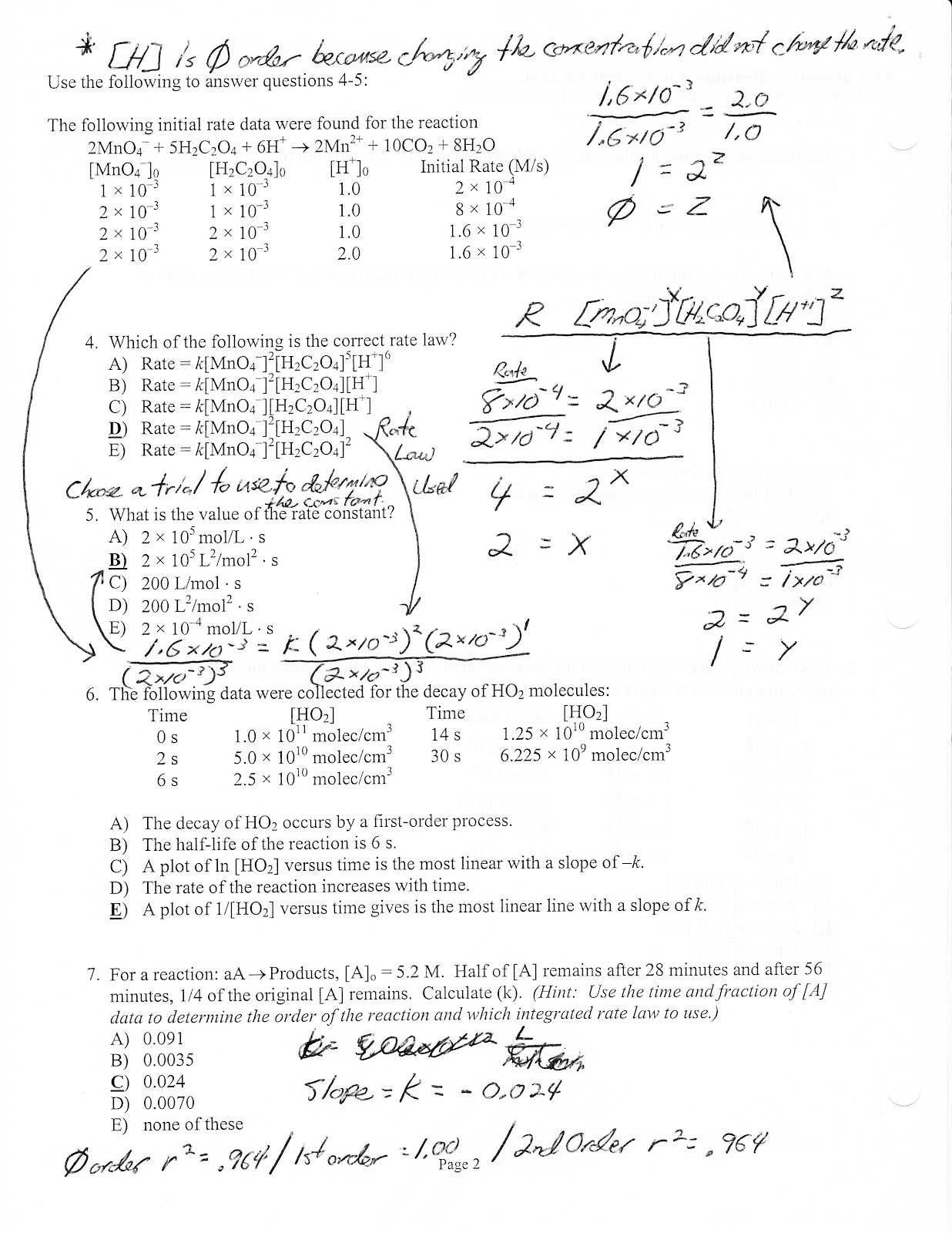
Below are scans of the practice quiz given out in class on Thursday. Unfortunately, I cannot upload the pdf of the practice exam like I said in an earlier post. If you did not get a copy of the practice exam, you will just have to use the images below. Also, an explanation to problem #19 is below. Also, the practice exam did not cover any nuclear material from the Chapter 21 work packet. There will be questions pertaining to nuclear chemistry on Monday's exam.

  • Problem #19 could be solved with a calculation using the equation to find activation energy (Arrenius Equation - don't worry about the name). A simpler way (and the expected way) is to notice the trend of increase in temperature and rate constants. The increase in temperature of 20 Kelvin (273 K to 293 K) had a rate constant "k" increase of 0.046 to 0.081. A roughly 20 Kelvin increase in temperature (293 K to 310 K) should also cause another 0.04X increase in the rate constant. Therefore, 0.081 + 0.04 = 0.12.

Integrated and Differentiated Rate Law Quiz Solutions

Below are the solutions guides to the quiz handed in on Thursday. I will try and grade the quiz and input your grades into Infinite Campus by Sunday morning so you can gauge how well you did.

Friday, February 3, 2012

Snow Day! Snow Day!

I hope everyone took the opportunity to sleep in. Great thing about this snow day is we can accomplish everything needed to get ready for Monday's Chapter 14 and 21 exam from the comfort of our own homes. Please periodically keep coming back to blog for information over the weekend. I will be doing the following:
  1. I will post a pdf copy of the practice exam on the Events Calendar if you did not get a copy in class. It will be under the date Friday, February 3rd.
  2. I will post a solutions guide to the practice exam on the blog. Look for that either later today or tomorrow (Saturday, 2/4).
  3. I will post a detailed explanation of the exam later on the blog. The test will be both multiple choice and free-response / written questions from old AP Chemistry exams.
  4. All VODCasts for the work packets (Chapters 21 and 14) given have been posted on the Events Calendar. They exist in the months of January and February, so you will have to go between the two months. I will be collecting the packets on Monday and giving you credit for completing the packets. Please do not just copy answers, but actually try to work the problems. The work packets are your best means of preparing for the exam.
  5. I had hoped to return your take home quizzes to you today in class. Even though I cannot do that, I will be posting the solutions on the blog later.

I will check my email regularly throughout the weekend. You can also call my cell phone. If you do not have my number, email me and I will send it to you. Have fun with your snow day. I am going sledding later.

Mr. B